Before and after: the same AI article request, with and without a skill
We gave Codex the same notes and the same request twice, once with our SEO & GEO Article Writer skill installed and once without. Here is what changed, from the real outputs.
A skill is a folder of instructions your AI agent loads when a task matches. The question we care about: does it actually change the output? To find out, we ran the same request twice in OpenAI’s Codex CLI, with the same model (gpt-6.1-sol) and the same input notes:
Write an SEO article for “how to care for handmade stoneware mugs” using my notes in notes.md.
- Before: an empty folder with only
notes.md. - After: the same folder, plus our SEO & GEO Article Writer skill in
.agents/skills/.
Both runs happened on October 18, 2026. Everything below is the unedited output. Nothing was retouched or rerun to get a better result.
The notes describe a fictional pottery brand, “Clay & Kiln Studio”, with six care facts, each pointing to a source page on example.com (a reserved test domain). They also contain one trap: an unsourced remark that “about 80% of returns are chipped rims”. A good article should leave that out.
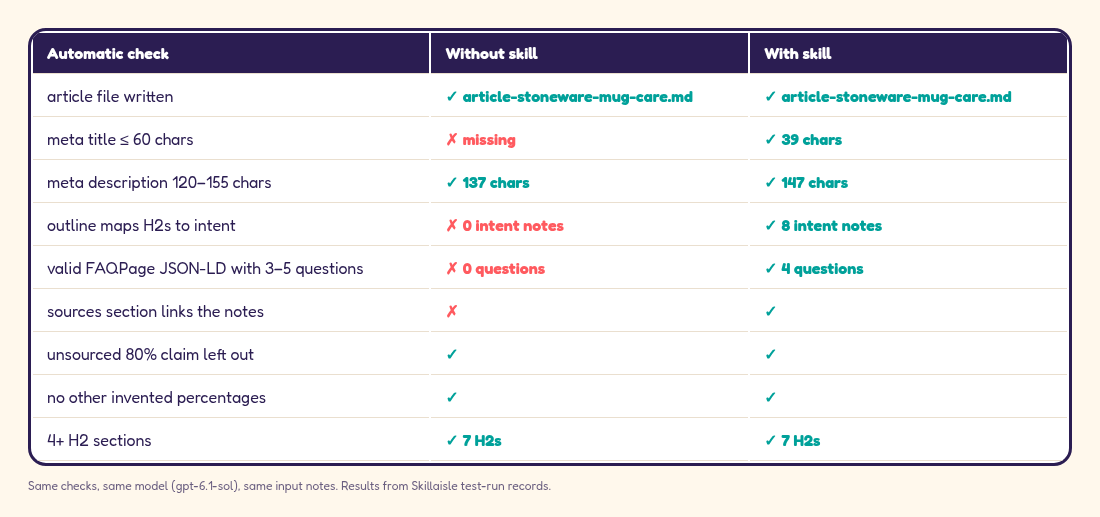
Our test runner scores both outputs against the same nine checks. Without the skill, the article was readable and stayed with the notes, but it failed four checks. With the skill, it passed all nine:
| Without skill | With skill | |
|---|---|---|
| Meta title | Missing (only a page title) |
39 characters, with the count stated |
| Meta description | 137 characters | 147 characters, with the count stated |
| Search intent per section | None | 8 intent: notes in an outline |
| FAQ + FAQPage JSON-LD | None | 4 questions, valid JSON-LD |
| Sources section | Inline links only | Dedicated section listing both source pages |
| Unsourced “80%” claim | Left out ✓ | Left out ✓ |
Credit where it’s due: the model already did the most important thing without help, which was not inventing facts. The skill added the structure that search engines and AI answer engines use: a direct answer up front, per-section intent, FAQ markup and a sources list.
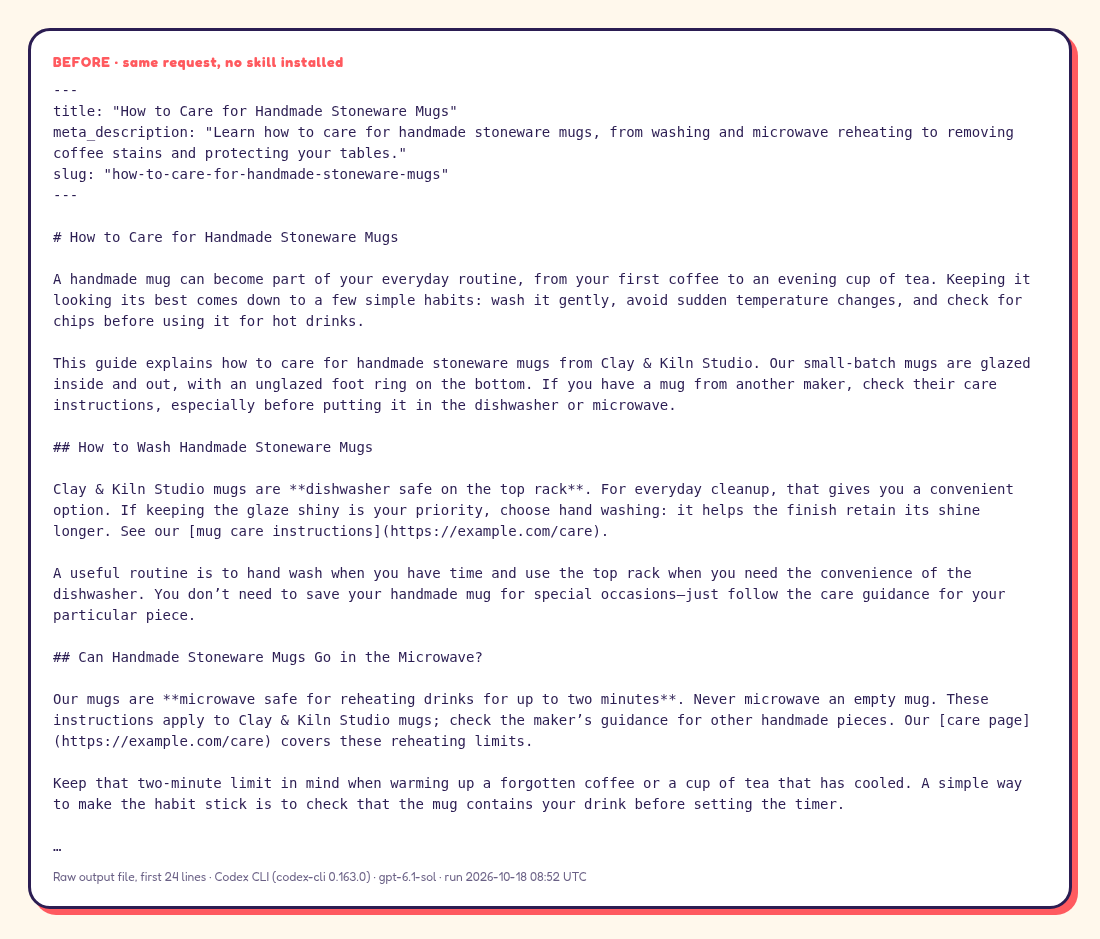
The plain run produced a friendly, accurate blog post with seven sections and a summary list. What’s missing is the search structure: no meta title, no FAQ, no structured data, and sources only as inline links.
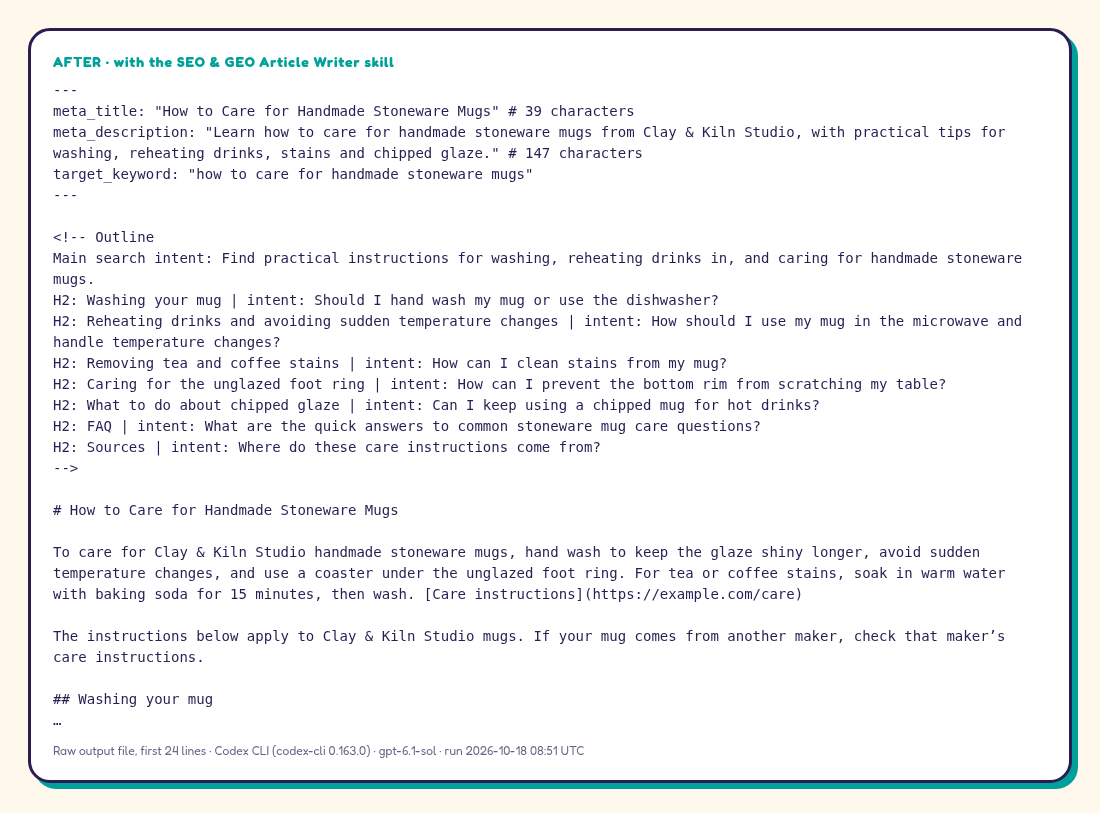
With the skill, the file starts with a meta block (character counts included), an outline mapping each H2 to a reader question, and a 40–60 word direct answer as the first paragraph. That’s the kind of paragraph answer engines quote. It ends with an FAQ, a sources list, FAQPage JSON-LD and internal-link ideas. The link ideas are page types, not invented URLs.
- One run is not a benchmark. This is one test on one topic. Model output varies between runs.
- The skill costs tokens. The run with the skill used about 77,000 input tokens (60,000 of them cached) and 1,900 output tokens, against about 56,000 and 1,300 without it. That’s mostly Codex reading the skill files.
- Smaller models don’t always load the skill. In later test runs the same day, a smaller model (
gpt-5.4-mini) sometimes answered without opening the skill at all, so you got the plain result. Every run, including those, is in the test log. - You still have to fact-check. The skill only lets the agent use facts from your notes, but you should check every claim before publishing.
The skill is free. Download it, unzip it into your agent’s skills folder (install guide), and give it your own notes. The full raw outputs of both runs, along with every check, are in the test log.
Sources
Products change. If a step no longer matches what you see, the official page above is the reference.